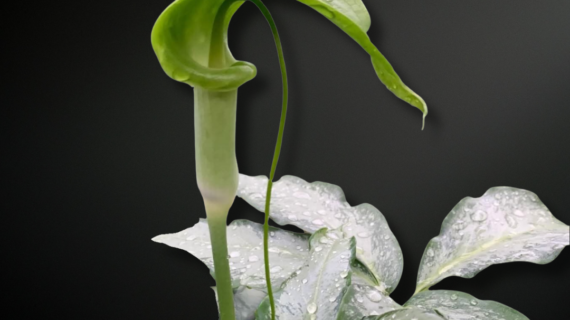
Arisaema filiforme — The Thread-Spathed Phantom of Mountain Forests
Among the most enigmatic members of the cobra lily lineage, Arisaema filiforme possesses a visual language unlike nearly any other woodland aroid. Slender, elongated, and almost spectral in form, the species emerges from shaded forest soils with a quiet intensity shaped by mist, altitude, and seasonal transformation. Its narrow spathe and impossibly extended filament-like spadix create an appearance that feels more calligraphic than botanical — a living gesture suspended in humid mountain air.
Unlike broader and more dramatic Arisaema species that command attention through bold striping or heavy proportions, Arisaema filiforme captivates through restraint and precision. The bloom appears delicate from a distance, yet upon closer observation reveals remarkable structural sophistication. Meanwhile, the finely divided foliage introduces additional lightness, reinforcing the species’ ethereal character beneath forest canopy.
For collectors, Arisaema filiforme represents a rare convergence of elegance, rarity, and ecological atmosphere. The species feels inseparable from the cool mountain forests that shaped it, carrying within its structure the quiet tension of fog, stone, and seasonal stillness.
Botanical Significance
Collector Value
Within woodland aroid collections, Arisaema filiforme remains highly admired for its elongated thread-like spadix extension and refined floral architecture. Mature flowering specimens possess an almost surreal visual quality rarely encountered among temperate geophytes.
Moreover, cultivated material remains relatively scarce outside specialist Arisaema collections and alpine botanical circles. Consequently, established specimens command significant admiration among collectors focused on unusual Asian woodland species and refined morphological forms.
For collectors, the species offers a deeply seasonal cultivation experience. Each emergence unfolds with measured elegance, gradually revealing increasingly complex floral posture and foliage structure over successive years.
Distinctive Morphology
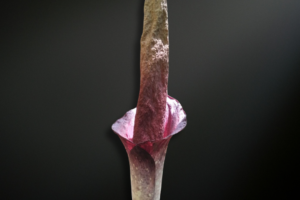
The defining characteristic of Arisaema filiforme lies in its elongated filiform spadix appendage, which extends dramatically beyond the floral chamber like a suspended thread drifting through the understory. This remarkable structure gives the species its unmistakable silhouette and contributes greatly to its spectral atmosphere.
Meanwhile, the spathe itself often displays subdued green, olive, or muted earth-toned coloration that blends seamlessly into moss-covered forest surroundings. Fine striping or subtle tonal transitions occasionally emerge depending on maturity and environmental conditions.
Above the inflorescence, the foliage develops elegant divided leaflets carried on slender petioles with remarkable balance and delicacy. Unlike more robust cobra lilies, Arisaema filiforme conveys sophistication through vertical tension and visual lightness.
Habitat & Origin
Native Environment
Arisaema filiforme originates from cool humid mountain forests of East Asia, where mist, rainfall, and dense canopy systems create stable woodland environments rich in decomposing organic matter and mineral soil.
In habitat, the species develops among moss-covered stone, forest humus, fern colonies, and shaded slopes protected from harsh sunlight. Filtered illumination reaches the forest floor softly through layered canopy cover while seasonal moisture patterns shape annual growth cycles.
Consequently, the species evolved to thrive within cool, humid, and highly oxygenated woodland ecosystems marked by strong seasonal transitions.
Ecological Adaptations
Like many temperate woodland aroids, Arisaema filiforme survives through a subterranean tuber that stores nutrients and moisture between active growth periods. This adaptation allows the species to retreat completely below ground during winter dormancy while preserving energy for future emergence.
Its elongated floral appendage likely contributes to specialized pollination strategies involving scent dispersal and insect guidance within dense forest understory conditions. Additionally, the slender foliage structure minimizes mechanical damage from rainfall and shifting mountain airflow.
Because of these ecological adaptations, the species maintains a highly refined balance between delicacy and resilience.
Why Collectors Seek Arisaema filiforme
Rarity
Authentic cultivated specimens of Arisaema filiforme remain relatively uncommon outside specialist woodland and alpine plant collections. Because propagation progresses gradually and flowering requires stable seasonal conditions over multiple years, mature specimens become increasingly prized over time.
Moreover, the species’ highly unusual floral silhouette immediately separates it from more commonly cultivated cobra lilies. As a result, Arisaema filiforme holds strong fascination among collectors drawn toward rare temperate aroids and unusual botanical forms.
For many enthusiasts, flowering-sized plants represent years of careful cultivation and environmental refinement.
Architectural Presence
Despite its comparatively restrained scale, Arisaema filiforme creates extraordinary spatial tension through line and movement alone. The extended thread-like spadix introduces vertical drama without heaviness, while the surrounding foliage maintains an airy woodland elegance.
In cultivation, the species pairs beautifully with moss-covered stone, weathered ceramic containers, shaded alpine displays, and cool greenhouse environments inspired by mist-laden mountain forests.
Beyond this, the plant’s seasonal disappearance and re-emergence create an emotional rhythm deeply appreciated among woodland geophyte collectors.
Botanical Interest
From a botanical perspective, Arisaema filiforme offers exceptional insight into the extraordinary diversity of floral adaptation within Asian woodland aroids. Its elongated appendage, cool-climate adaptation, and highly refined structure distinguish it clearly from broader and more heavily ornamented relatives.
Unlike species cultivated primarily for dramatic coloration, this plant rewards close observation and ecological sensitivity. Over time, subtle changes in floral proportion, spathe posture, and tuber maturity reveal increasing sophistication.
Ultimately, the species appeals most strongly to collectors drawn toward restraint, atmosphere, and rare structural beauty.
Collector’s Perspective
Cultivating Arisaema filiforme often becomes an exercise in seasonal patience and environmental subtlety. During dormancy, the tuber rests invisibly beneath cool substrate layers while preserving the reserves necessary for future emergence. Then, with the arrival of spring moisture and warming temperatures, new growth rises quietly through moss and leaf litter.
Meanwhile, flowering introduces one of the most atmospheric moments within woodland plant cultivation. The elongated spadix extension appears almost unreal beneath diffused mountain light — delicate, suspended, and profoundly elegant.
Over time, mature specimens develop stronger seasonal vigor and increasingly refined floral presentation. Because of this gradual progression, collectors frequently cultivate individual plants for many years as treasured woodland rarities.
Flowering Characteristics
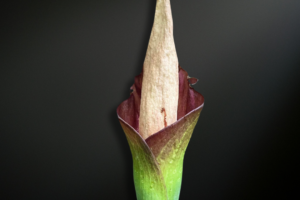
The inflorescence of Arisaema filiforme ranks among the most structurally distinctive within the genus. The narrow spathe encloses the floral chamber while the elongated thread-like spadix appendage extends outward with extraordinary grace and tension.
Flowering generally occurs alongside or slightly before full foliage expansion, allowing the inflorescence to remain visually prominent beneath woodland canopy conditions. Additionally, subtle scent production and floral architecture support specialized insect pollination strategies adapted to cool forest ecosystems.
Although the bloom remains seasonally brief, its sculptural elegance leaves lasting impression among collectors fortunate enough to witness mature specimens in flower.
Comparison With Related Species
Compared with broader and more heavily striped species such as Arisaema griffithii or Arisaema consanguineum, Arisaema filiforme expresses a far more restrained and linear visual language. Rather than relying on mass or bold contrast, it captivates through proportion and spatial delicacy.
In contrast to species with thick upright appendages, this plant emphasizes movement, extension, and atmospheric tension. Because of this, advanced collectors frequently regard it among the most refined and intellectually compelling species within the genus.
Additionally, its cool-climate woodland adaptation makes it especially valuable within alpine and temperate geophyte collections.
Looking for Rare Amorphophallus Species?
Explore our collection of rare tubers, seeds, and exotic aroids directly from Indonesia. Carefully prepared for international shipping.